🎯 MỤC TIÊU
Về kiến thức:
- Hiểu được quy trình peer review của một tạp chí y khoa.
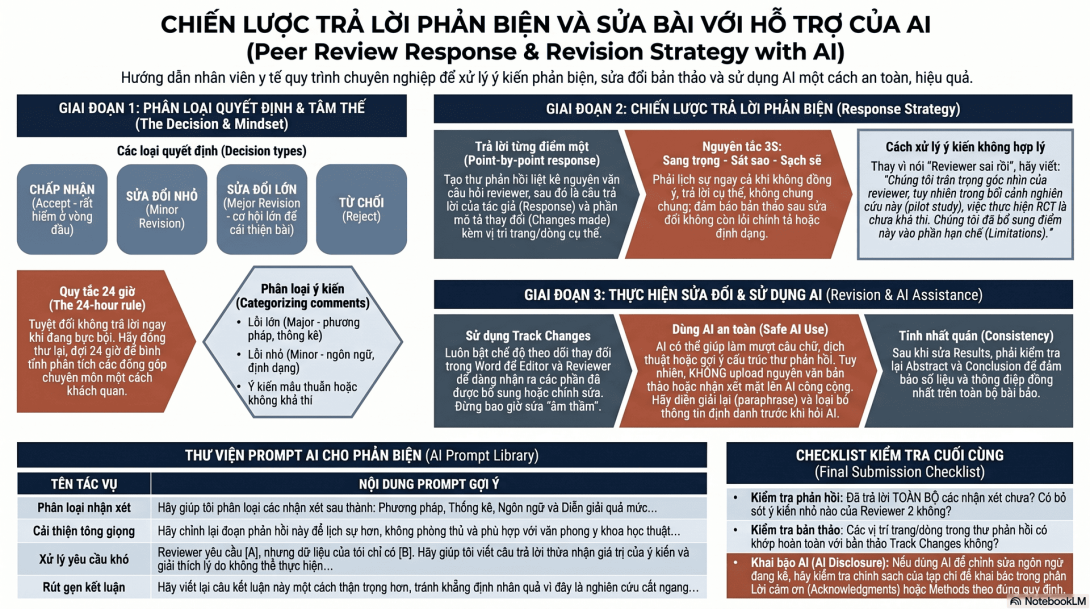
- Phân biệt được các quyết định thường gặp: accept, minor revision, major revision, reject, reject and resubmit.
- Nhận diện được các loại reviewer comments: major, minor, methodological, statistical, language, formatting, contradictory, unreasonable.
- Hiểu nguyên tắc viết response letter: lịch sự, đầy đủ, point-by-point, minh bạch.
- Biết các giới hạn đạo đức khi dùng AI trong peer review và revision.
Về kỹ năng:
- Phân loại được reviewer comments theo mức độ ưu tiên.
- Lập được revision plan sau khi nhận quyết định từ editor.
- Viết được response letter chuyên nghiệp bằng tiếng Anh.
- Sử dụng Word Track Changes để chỉnh manuscript.
- Xử lý được tình huống reviewer yêu cầu phân tích thêm, giải thích thêm, hoặc có ý kiến trái ngược nhau.
- Dùng AI an toàn để cải thiện cách diễn đạt response letter mà không vi phạm bảo mật.
Về thái độ:
- Không phản ứng phòng thủ khi đọc phản biện.
- Xem reviewer comments là cơ hội cải thiện bài, không phải cuộc tấn công cá nhân.
- Không dùng AI để xử lý tài liệu mật trái quy định.
- Giữ trách nhiệm tác giả: AI có thể giúp viết lịch sự hơn, nhưng tác giả phải quyết định nội dung khoa học.
Thông điệp chính:
Reviewer không phải “trùm cuối”. Reviewer là người chỉ ra những chỗ bản thảo còn yếu. Đôi khi họ nói hơi sắc, nhưng nếu xử lý tốt, bài của bạn có thể mạnh hơn rất nhiều.
PHẦN 1: PEER REVIEW PROCESS — QUY TRÌNH PHẢN BIỆN
1.1. Peer review là gì?
Peer review là quá trình bài báo được các chuyên gia cùng lĩnh vực đọc, đánh giá và góp ý trước khi tạp chí quyết định có đăng hay không.
Mục tiêu của peer review:
- Kiểm tra tính mới.
- Kiểm tra tính hợp lý của phương pháp.
- Kiểm tra phân tích dữ liệu.
- Kiểm tra diễn giải kết quả.
- Phát hiện lỗi logic, lỗi trình bày, lỗi đạo đức.
- Đảm bảo bài phù hợp với độc giả của tạp chí.
1.2. Các bước thường gặp
Theo khung chương trình gốc, quy trình gồm editor screening, phân công reviewer, nhận review từ 2–3 reviewers, rồi ra quyết định: accept, minor/major revision hoặc reject.
1. Submission received
2. Technical check
3. Editor screening
4. Reviewer invitation
5. Peer review
6. Editor decision
7. Revision / rejection / acceptance
Bước 1: Technical check
Tạp chí kiểm tra:
- Đúng format chưa?
- File đủ chưa?
- Abstract đúng cấu trúc chưa?
- Reference đúng style chưa?
- Ethics statement có không?
- Figures đủ chất lượng không?
- Reporting checklist có không?
Nếu thiếu, bài có thể bị trả về trước khi editor đọc.
Bước 2: Editor screening
Editor đọc nhanh để xem:
- Bài có đúng scope không?
- Có đủ mới không?
- Có phù hợp chất lượng tạp chí không?
- Có lỗi nghiêm trọng không?
- Có đáng gửi reviewer không?
Nếu không phù hợp, bài có thể bị desk reject.
Bước 3: Reviewer assignment
Editor mời 2–3 reviewer hoặc hơn, tùy bài.
Reviewer có thể là:
- Chuyên gia chuyên ngành.
- Chuyên gia phương pháp.
- Chuyên gia thống kê.
- Biên tập viên chuyên môn.
- Reviewer về reporting guideline.
Bước 4: Decision letter
Sau khi nhận review, editor ra quyết định.
PHẦN 2: CÁC LOẠI QUYẾT ĐỊNH TỪ TẠP CHÍ
2.1. Accept
Rất hiếm ở vòng đầu. Nếu được accept ngay, xin chúc mừng, nhưng cũng kiểm tra xem mình có đang mơ không.
2.2. Minor Revision
Bài có khả năng được nhận cao nếu sửa tốt.
Thường yêu cầu:
- Sửa câu chữ.
- Bổ sung vài tài liệu.
- Làm rõ một số chi tiết.
- Chỉnh bảng/hình.
- Bổ sung statement.
2.3. Major Revision
Đây là tình huống rất thường gặp.
Yêu cầu có thể gồm:
- Mô tả lại phương pháp.
- Bổ sung phân tích.
- Sửa cách diễn giải.
- Rút bớt kết luận.
- Bổ sung sensitivity analysis.
- Sửa Discussion.
- Làm rõ ethical approval.
- Viết lại nhiều phần.
Major revision không phải reject. Nó nghĩa là bài còn cơ hội.
2.4. Reject but encourage resubmission
Bài bị từ chối ở dạng hiện tại, nhưng editor có thể mời gửi lại như bài mới sau khi sửa lớn.
2.5. Reject
Bài không phù hợp hoặc có vấn đề lớn. Vẫn có thể dùng comments để sửa rồi gửi tạp chí khác.
PHẦN 3: TÂM LÝ KHI NHẬN REVIEWER COMMENTS
3.1. Phản ứng thường gặp
Khi mở decision letter, nhiều tác giả sẽ trải qua 5 giai đoạn:
- Sốc: “Sao reviewer nói nặng vậy?”
- Phủ nhận: “Họ không hiểu bài mình.”
- Tức giận: “Reviewer 2 là ai mà khó thế?”
- Thương lượng: “Hay mình chỉ sửa mấy lỗi nhỏ thôi?”
- Chấp nhận: “Thôi, giờ phân loại comments và sửa.”
Reviewer 2 thường là nhân vật huyền thoại trong đời nghiên cứu. Không ai thấy mặt, nhưng ai cũng từng nghe tiếng.
3.2. Quy tắc 24 giờ
Không nên trả lời ngay khi còn bực.
Quy trình tốt:
Đọc decision letter
   ↓
Đóng lại 24 giờ
   ↓
Đọc lại bình tĩnh
   ↓
Phân loại comments
   ↓
Họp nhóm tác giả
   ↓
Lập revision plan
Không nên gửi email cho editor trong trạng thái “hơi sôi huyết áp”.
PHẦN 4: PHÂN LOẠI REVIEWER COMMENTS
Khung chương trình gốc chia comments thành major comments, minor comments và các comment có thể mâu thuẫn giữa reviewers.
4.1. Major comments
Đây là các comment ảnh hưởng đến khoa học cốt lõi của bài.
Ví dụ:
- Cỡ mẫu nhỏ, không có power calculation.
- Thiết kế nghiên cứu chưa rõ.
- Tiêu chuẩn chọn mẫu chưa hợp lý.
- Outcome chưa định nghĩa rõ.
- Phân tích thống kê chưa phù hợp.
- Chưa kiểm soát confounding.
- Kết luận vượt quá dữ liệu.
- Thiếu sensitivity analysis.
- Thiếu reporting checklist.
- Vấn đề đạo đức chưa rõ.
Cách xử lý
Major comments cần ưu tiên trước. Thường phải:
- Sửa Methods.
- Chạy phân tích bổ sung.
- Thêm bảng/phụ lục.
- Rút bớt kết luận.
- Bổ sung limitations.
- Giải thích rõ vì sao không thể làm nếu request không khả thi.
4.2. Minor comments
Là các góp ý nhỏ hơn, thường liên quan đến clarity, language, references, formatting.
Ví dụ:
- Câu dài khó hiểu.
- Sai chính tả.
- Thiếu định nghĩa viết tắt.
- Reference thiếu cập nhật.
- Figure legend chưa rõ.
- Table format chưa đẹp.
- Dùng thuật ngữ chưa nhất quán.
Cách xử lý
Sửa đầy đủ, ghi rõ đã sửa ở đâu.
Không xem thường minor comments. Một bài có science tốt nhưng trình bày lộn xộn vẫn khiến reviewer khó chịu. Reviewer cũng là con người, không phải máy đọc PDF chống mỏi mắt.
4.3. Comments về phương pháp
Ví dụ:
“The Methods section lacks detail on intervention delivery.”
Cần bổ sung:
- Ai thực hiện can thiệp?
- Can thiệp diễn ra ở đâu?
- Tần suất bao nhiêu?
- Mỗi buổi kéo dài bao lâu?
- Nội dung can thiệp là gì?
- Có training người thực hiện không?
- Có kiểm tra fidelity không?
- Có protocol chuẩn không?
4.4. Comments về thống kê
Ví dụ:
“The authors should adjust for potential confounders.”
Cần xem:
- Reviewer nói đúng không?
- Có biến confounders nào đã thu thập không?
- Mô hình hồi quy phù hợp không?
- Có đủ events per variable không?
- Có cần sensitivity analysis không?
- Nếu không thể làm, lý do là gì?
4.5. Comments về diễn giải quá mức
Ví dụ:
“The Discussion overstates the findings.”
Đây là comment rất thường gặp.
Cần sửa các câu kiểu:
Our intervention proves that mindfulness reduces stress in all ICU nurses.
Thành:
Our findings suggest that the mindfulness intervention may reduce perceived stress among ICU nurses in this single-center study. Further studies with larger samples and longer follow-up are needed to confirm these findings.
4.6. Comments mâu thuẫn giữa reviewers
Ví dụ từ khung chương trình:
- Reviewer 1: “Add subgroup analysis.”
- Reviewer 2: “Too many analyses, simplify.”
Chiến lược phản hồi: ghi nhận cả hai, giải thích quyết định và nêu lý do.
Ví dụ:
We thank both reviewers for these helpful suggestions. To balance the need for additional clinical insight with the concern about excessive analyses, we have added one pre-specified subgroup analysis by age group, which is clinically relevant to the study question. We have avoided further exploratory subgroup analyses and clarified this decision in the Methods section.
4.7. Comments không hợp lý hoặc không khả thi
Ví dụ từ khung chương trình:
“Conduct an additional RCT to validate findings.”
Với một nghiên cứu quan sát hoặc pilot study, yêu cầu này có thể không khả thi trong revision. Cách xử lý là lịch sự từ chối, giải thích giới hạn và đề xuất nghiên cứu tương lai.
Ví dụ:
We appreciate the reviewer’s suggestion. We agree that a randomized controlled trial would provide stronger evidence. However, conducting an additional RCT is beyond the scope and feasibility of the current revision. We have now acknowledged this limitation in the Discussion and highlighted the need for future randomized studies.
PHẦN 5: NGUYÊN TẮC VÀNG KHI TRẢ LỜI REVIEWER
Khung chương trình gốc nêu các “golden rules”: không phòng thủ hoặc thô lỗ, luôn cảm ơn reviewer, trả lời từng điểm, minh bạch về điều đã sửa/chưa sửa, và cố gắng hoàn thành trong 2–4 tuần.
5.1. Trả lời mọi comment
Không bỏ sót comment nào.
Nếu reviewer có 15 comments, response letter phải có 15 câu trả lời rõ ràng.
5.2. Lịch sự, kể cả khi không đồng ý
Không viết:
The reviewer is wrong.
Nên viết:
We respectfully disagree with this point because...
Hoặc:
We appreciate the reviewer’s perspective. However, we believe that...
5.3. Cụ thể, không chung chung
Không viết:
We revised the manuscript.
Nên viết:
We have revised the Methods section to include details on intervention duration, frequency, facilitator training, and adherence monitoring (page 6, lines 132–148).
5.4. Ghi rõ vị trí sửa
Nên ghi:
- Page.
- Line.
- Section.
- Table/Figure number.
- Supplementary material nếu có.
Ví dụ:
Changes made: We added the sample size calculation in the Methods section, page 5, lines 118–126.
5.5. Không tranh luận cảm tính
Response letter không phải nơi “thắng thua” với reviewer. Mục tiêu là thuyết phục editor rằng bạn nghiêm túc, hợp tác và đã cải thiện bài.
PHẦN 6: CẤU TRÚC RESPONSE LETTER
6.1. Cấu trúc tổng quát
Dear Editor,

We thank you and the reviewers for the constructive comments on our manuscript entitled “[Title]”. We have carefully revised the manuscript and addressed each comment point by point. All changes have been highlighted using Track Changes.

Below, we provide a detailed response to each comment.

Reviewer 1

Comment 1:
[Reviewer comment]

Response:
[Your response]

Changes made:
[Location of change]

Reviewer 2

Comment 1:
...

Sincerely,
[Corresponding author on behalf of all authors]
6.2. Mẫu response letter hoàn chỉnh
Khung chương trình gốc cung cấp cấu trúc response letter gồm lời cảm ơn, trả lời từng reviewer, ghi rõ thay đổi trong manuscript và kết thư.
Dear Editor,

We thank you and the reviewers for the constructive comments and thoughtful suggestions regarding our manuscript entitled “[Manuscript Title]”. We have carefully revised the manuscript in response to each comment. All changes have been made using Track Changes and are highlighted in the revised manuscript.

Reviewer 1

Comment 1: “Sample size seems small. Did the authors perform power calculation?”

Response: Thank you for this important comment. We agree that the sample size should be justified more clearly. We performed an a priori sample size calculation based on the expected difference in the primary outcome. We have now added the details of this calculation to the Methods section.

Changes made: We added the sample size calculation in the Methods section, page 5, lines 120–128.

Comment 2: “The Methods section lacks detail on intervention delivery.”

Response: We apologize for the lack of clarity. We have expanded the Methods section to describe the intervention provider, session duration, frequency, content, and adherence monitoring.

Changes made: The Methods section has been revised on pages 6–7, lines 145–172.

Reviewer 2

Comment 1: “The Discussion overstates the findings.”

Response: Thank you for pointing this out. We agree and have revised the Discussion to use more cautious language. We now state that the findings suggest a potential benefit rather than prove effectiveness.

Changes made: The Discussion section has been revised on page 12, lines 310–326.

We believe these revisions have substantially strengthened the manuscript. We hope that the revised version is now suitable for publication in [Journal Name].

Sincerely,

[Name]
On behalf of all authors
PHẦN 7: CÁC LOẠI RESPONSE THƯỜNG DÙNG
7.1. Khi đồng ý và đã sửa
Thank you for this helpful comment. We agree with the reviewer and have revised the manuscript accordingly.
Ví dụ:
Thank you for this helpful comment. We agree that the intervention delivery should be described in more detail. We have expanded the Methods section to include information on the facilitator, session frequency, duration, and intervention materials.
7.2. Khi đồng ý một phần
We agree with the reviewer that this issue is important. However, due to [reason], we were not able to [specific request]. We have addressed this by [alternative action].
Ví dụ:
We agree that longer follow-up would provide valuable information. However, the current study was designed with a 12-week follow-up period, and additional follow-up data are not available. We have now acknowledged this limitation in the Discussion and suggested longer-term studies in future research.
7.3. Khi không đồng ý
We appreciate the reviewer’s suggestion. However, we respectfully believe that [your rationale]. Therefore, we have retained [original approach], while clarifying [relevant point] in the manuscript.
Ví dụ:
We appreciate the reviewer’s suggestion to dichotomize the stress score. However, because dichotomization may reduce statistical power and lose information, we retained the continuous score as the primary outcome. We have clarified this rationale in the Statistical Analysis section.
7.4. Khi không thể thực hiện yêu cầu
We appreciate this suggestion. Unfortunately, [requested analysis/data collection] is not feasible because [reason]. We have now acknowledged this limitation and discussed its implications.
Ví dụ:
We appreciate the reviewer’s suggestion to include a biomarker analysis. Unfortunately, biomarker data were not collected in this study and cannot be obtained retrospectively. We have acknowledged this limitation in the Discussion.
7.5. Khi reviewer hiểu nhầm
Không nên nói “reviewer misunderstood”. Nên tự nhận là manuscript chưa rõ.
We apologize for the lack of clarity in the original manuscript. We have revised the text to clarify that...
Ví dụ:
We apologize for the lack of clarity. The intervention was delivered by trained nurses, not external psychologists. We have revised the Methods section to clarify this point.
PHẦN 8: SỬA MANUSCRIPT BẰNG WORD TRACK CHANGES
8.1. Vì sao dùng Track Changes?
Track Changes giúp editor và reviewer thấy bạn đã sửa gì.
Cần bật Track Changes khi:
- Thêm đoạn mới.
- Xóa câu.
- Sửa số liệu.
- Chỉnh bảng.
- Chỉnh Discussion.
- Thêm limitation.
- Thay đổi conclusion.
8.2. Quy trình sửa bài
Tạo bản copy manuscript
   ↓
Bật Track Changes
   ↓
Sửa theo từng comment
   ↓
Ghi lại location vào response letter
   ↓
Kiểm tra consistency
   ↓
Tạo clean version nếu tạp chí yêu cầu
8.3. Nên lưu các file thế nào?
Manuscript_original_submitted.docx
Manuscript_revised_track_changes.docx
Manuscript_revised_clean.docx
Response_to_reviewers.docx
Revision_checklist.xlsx
Đặt tên file rõ ràng. Đừng tạo “final.docx”, “final_final.docx”, “final_really_final.docx”, rồi đến “final_nop_sang_mai.docx”. Đó là bẫy cổ điển, nhiều nhóm nghiên cứu đã ngã.
PHẦN 9: AI TRONG TRẢ LỜI PHẢN BIỆN — DÙNG SAO CHO AN TOÀN?
Khung chương trình gốc cảnh báo: một số tạp chí cấm hoặc hạn chế dùng AI trong peer review; không được upload manuscript của người khác lên AI; có thể dùng AI để cải thiện response letter nếu không chia sẻ thông tin mật.
9.1. AI có thể giúp gì?
AI có thể hỗ trợ:
- Phân loại comments.
- Gợi ý cấu trúc response letter.
- Làm câu trả lời lịch sự hơn.
- Dịch response từ tiếng Việt sang tiếng Anh.
- Rút gọn câu quá dài.
- Kiểm tra tone có phòng thủ không.
- Tạo checklist sửa bài.
- Gợi ý cách giải thích limitation.
- Gợi ý cách nói “không thể làm” một cách chuyên nghiệp.
9.2. AI không được làm gì?
Không dùng AI để:
- Upload toàn bộ manuscript chưa công bố nếu có chính sách bảo mật nghiêm ngặt.
- Upload reviewer comments verbatim nếu tạp chí cấm hoặc xem là confidential.
- Upload manuscript của người khác khi bạn là reviewer.
- Tạo dữ liệu mới để đáp ứng reviewer.
- Bịa phân tích bổ sung.
- Viết câu trả lời sai sự thật.
- Che giấu việc dùng AI nếu tạp chí yêu cầu disclosure.
Bài 2 đã nhấn mạnh các rủi ro chính khi sử dụng AI gồm hallucination, bias, vi phạm bảo mật, mất tư duy phản biện và trách nhiệm sử dụng AI có kiểm chứng.
9.3. Cách dùng AI an toàn
Thay vì dán nguyên văn toàn bộ reviewer comments và manuscript, hãy paraphrase và loại bỏ thông tin nhạy cảm.
Ví dụ an toàn từ khung chương trình:
Help me structure a response to this reviewer comment (paraphrased):
'The study lacks generalizability due to single-center design.'

Context: It was a pilot study, multi-center was not feasible due to budget.
How should I respond professionally while acknowledging limitation?
Cách này giúp AI hỗ trợ văn phong mà không lộ nội dung mật.
9.4. Prompt AI phân loại comments
Tôi đang chuẩn bị response letter cho một manuscript y khoa.

Dưới đây là các reviewer comments đã được tôi paraphrase và loại bỏ thông tin nhận diện:

1. [Comment 1]
2. [Comment 2]
3. [Comment 3]

Hãy giúp tôi phân loại từng comment thành:
- Major methodological issue
- Statistical issue
- Interpretation issue
- Minor clarification
- Language/style
- Formatting
- Unreasonable/not feasible
- Contradictory with another comment

Sau đó đề xuất chiến lược phản hồi cho từng comment.

Không thêm dữ liệu, không giả định kết quả nghiên cứu.
9.5. Prompt AI cải thiện tone
Dưới đây là bản nháp response của tôi cho reviewer:

[Draft response đã ẩn thông tin nhạy cảm]

Hãy chỉnh lại để:
1. Lịch sự hơn
2. Không phòng thủ
3. Rõ ràng hơn
4. Giữ đúng nội dung khoa học
5. Không thêm thông tin mới
6. Dùng văn phong phù hợp response letter cho tạp chí y khoa
9.6. Prompt AI khi không thể làm theo reviewer
Reviewer yêu cầu:
[Paraphrase yêu cầu]

Bối cảnh:
- Nghiên cứu hiện tại là:
- Dữ liệu hiện có:
- Lý do không thể thực hiện:
- Tôi có thể bổ sung limitation hoặc future research:

Hãy giúp tôi viết response lịch sự, thừa nhận giá trị của góp ý, giải thích vì sao không thể thực hiện trong revision hiện tại, và nêu thay đổi phù hợp trong manuscript.
PHẦN 10: THỰC HÀNH TRÊN LỚP
Theo khung chương trình gốc, bài thực hành đặt trong tình huống học viên nhận quyết định “Major Revision” với comments từ 2 reviewers; Reviewer 1 có các comment về cỡ mẫu, Methods thiếu chi tiết, Discussion nói quá mức và Figure 2 chưa rõ.
Tổng thời lượng thực hành: 55–60 phút
Thực hành 1: Triage comments — 15 phút
Tình huống
Bạn nhận quyết định:
Decision: Major Revision
Reviewer 1:
- “Sample size seems small. Did authors perform power calculation?”
- “Methods section lacks detail on intervention delivery.”
- “Discussion overstates findings.”
- “Figure 2 is unclear.”
Reviewer 2:
- “The authors should clarify inclusion and exclusion criteria.”
- “Please provide more information on missing data.”
- “The conclusion should be more cautious.”
- “English language requires editing.”
Nhiệm vụ
Phân loại từng comment:
| Comment | Loại | Mức ưu tiên | Cần làm gì? |
|---|---|---|---|
| Sample size small | Major/statistical | Cao | Bổ sung power/sample size hoặc limitation |
| Methods lacks detail | Major/methods | Cao | Mở rộng Methods |
| Discussion overstates | Interpretation | Cao | Viết lại Discussion |
| Figure unclear | Minor/figure | Trung bình | Chỉnh figure và legend |
| Inclusion criteria unclear | Methods | Cao | Bổ sung tiêu chuẩn chọn/loại |
| Missing data | Statistical/data quality | Cao | Mô tả tỷ lệ thiếu và cách xử lý |
| Conclusion cautious | Interpretation | Trung bình | Rút bớt kết luận |
| English editing | Language | Trung bình | Dùng Paperpal/Grammarly hoặc chỉnh thủ công |
Thực hành 2: Draft response letter — 20 phút
Nhiệm vụ
Viết response cho ít nhất 4 comments.
Mẫu bảng làm việc
| Reviewer | Comment | Action in manuscript | Draft response |
|---|---|---|---|
| R1 | Sample size small | Add power calculation | |
| R1 | Methods lacks detail | Expand intervention description | |
| R1 | Discussion overstates | Revise wording | |
| R1 | Figure 2 unclear | Replace figure |
Mẫu response
Comment 1: “Sample size seems small. Did authors perform power calculation?”

Response: Thank you for this important comment. We agree that the sample size justification was not sufficiently described in the original manuscript. We performed an a priori sample size calculation based on the expected effect size for the primary outcome. We have now added these details to the Methods section.

Changes made: The sample size calculation has been added to the Methods section, page 5, lines 118–126.
Thực hành 3: Implement revisions bằng Track Changes — 15 phút
Nhiệm vụ
Sử dụng manuscript mẫu hoặc manuscript của học viên.
- Bật Track Changes.
- Thêm đoạn sample size calculation.
- Mở rộng Methods.
- Viết lại 2 câu trong Discussion.
- Thay Figure 2 hoặc sửa figure legend.
- Ghi lại page/line để đưa vào response letter.
Checklist
- Track Changes đã bật.
- Tất cả thay đổi nhìn thấy được.
- Không sửa âm thầm trong bản clean.
- Page/line được ghi lại.
- Response letter khớp với manuscript.
Thực hành 4: Difficult situations — 10 phút
Case A: Reviewer mâu thuẫn
Reviewer 1:
“Add subgroup analysis.”
Reviewer 2:
“There are too many analyses; simplify the Results.”
Nhiệm vụ: Viết response cân bằng.
Gợi ý:
We thank both reviewers for these helpful comments. To address Reviewer 1’s concern while avoiding excessive exploratory analyses as noted by Reviewer 2, we have added one clinically justified subgroup analysis specified in the revised Methods section. We have removed other exploratory analyses from the main text and moved supporting results to the Supplementary Material.
Case B: Reviewer yêu cầu không khả thi
Reviewer:
“Conduct an additional randomized controlled trial to validate the findings.”
Gợi ý response:
We appreciate the reviewer’s suggestion and agree that a randomized controlled trial would provide stronger evidence. However, conducting an additional RCT is beyond the scope of the current revision. We have revised the Discussion to acknowledge this limitation and to recommend future randomized studies to confirm our findings.
PHẦN 11: CASE STUDY THẢO LUẬN
Case 1: Reviewer nói “sample size too small”
Comment
“The sample size appears small. Please justify whether the study was adequately powered.”
Phản hồi yếu
We think the sample size is enough.
Vấn đề
- Quá chủ quan.
- Không có bằng chứng.
- Không nói đã sửa gì.
Phản hồi tốt
Thank you for this important comment. We agree that the sample size justification should be clearly described. We have now added the sample size calculation to the Methods section. Based on an expected difference of [x] in the primary outcome, alpha of 0.05, and power of 80%, the required sample size was [n]. Our final sample size of [n] met this requirement.

Changes made: Added sample size calculation in Methods, page 5, lines 120–128.
Nếu không có power calculation ban đầu?
Thank you for this important comment. We acknowledge that an a priori power calculation was not performed, which is a limitation of the study. We have now clarified that this was an exploratory study and added this point to the Limitations section. We have also avoided definitive claims regarding effectiveness.
Case 2: Reviewer yêu cầu phân tích thêm nhưng dữ liệu thiếu
Comment
“Please adjust for socioeconomic status.”
Thực tế
Nghiên cứu không thu thập socioeconomic status.
Response tốt
We agree that socioeconomic status may influence the outcome and would be an important covariate. However, this variable was not collected in the current study and therefore could not be included in the multivariable model. We have acknowledged this as a limitation in the Discussion and noted that future studies should collect socioeconomic indicators.
Case 3: Reviewer yêu cầu thêm reference mới
Comment
“The authors should cite more recent literature.”
Cách xử lý
- Tìm bài thật.
- Ưu tiên systematic review, guideline, nghiên cứu lớn.
- Không để AI bịa reference.
- Cập nhật Introduction/Discussion.
Response
Thank you for this suggestion. We have updated the Introduction and Discussion by adding three recent studies relevant to [topic]. These references provide more current context for our findings.

Changes made: Added references [12–14] in the Introduction, page 3, lines 65–78, and Discussion, page 11, lines 280–292.
Case 4: Reviewer nói kết luận quá mạnh
Câu ban đầu
This intervention is effective and should be implemented in all hospitals.
Sửa lại
This intervention may be a feasible approach to reduce perceived stress among ICU nurses in this setting. Further multicenter studies with larger samples are needed before broader implementation.
Response
Thank you for pointing this out. We agree that the original conclusion was too strong for the study design and sample size. We have revised the Conclusion to use more cautious language and to emphasize the need for further multicenter studies.
Case 5: Reviewer hiểu sai vì mình viết chưa rõ
Comment
“It is unclear whether the intervention was delivered by physicians or nurses.”
Response
We apologize for the lack of clarity. The intervention was delivered by trained ICU nurses under the supervision of the research team. We have revised the Methods section to clarify the personnel involved and the training process.
Câu “we apologize for the lack of clarity” rất hữu ích. Nó không nhận sai khoa học, nhưng nhận rằng cách viết chưa đủ rõ.
PHẦN 12: RESPONSE LETTER STYLE — NÊN VÀ KHÔNG NÊN
12.1. Nên viết
| Tình huống | Câu nên dùng |
|---|---|
| Cảm ơn | Thank you for this helpful comment. |
| Đồng ý | We agree with the reviewer and have revised the manuscript accordingly. |
| Làm rõ | We have clarified this point in the revised Methods section. |
| Không thể làm | Unfortunately, these data were not collected in the current study. |
| Không đồng ý | We respectfully disagree because... |
| Reviewer hiểu nhầm | We apologize for the lack of clarity. |
| Đã sửa | Changes made: page X, lines Y–Z. |
12.2. Không nên viết
| Không nên | Vì sao |
|---|---|
| The reviewer is wrong. | Phòng thủ, thiếu chuyên nghiệp |
| This is impossible. | Quá cụt |
| We already said this. | Dễ gây khó chịu |
| This comment is irrelevant. | Thiếu tôn trọng |
| No change made. | Nếu không giải thích sẽ rất yếu |
| We used AI to answer all comments. | Nguy hiểm nếu không đúng chính sách |
PHẦN 13: KIỂM TRA LẠI MANUSCRIPT SAU REVISION
Sau khi sửa từng comment, cần đọc toàn bài một lần nữa.
13.1. Kiểm tra consistency
- Số liệu trong Abstract có khớp Results không?
- Methods có khớp phân tích mới không?
- Table/Figure numbering có thay đổi không?
- References có cập nhật đúng không?
- Conclusion có còn quá mạnh không?
- Supplementary files có được nhắc đúng không?
- Line numbers có đúng sau khi sửa không?
13.2. Kiểm tra response letter
- Có trả lời mọi comment không?
- Có bỏ sót comment nhỏ không?
- Có ghi page/line không?
- Có câu nào nghe phòng thủ không?
- Có hứa làm gì nhưng manuscript không có không?
- Có nói “added” nhưng thực ra chưa thêm không?
- Có mâu thuẫn giữa response và manuscript không?
PHẦN 14: PROMPT THƯ VIỆN CHO BÀI 17
Prompt 1: Phân loại comments
Tôi nhận reviewer comments đã được paraphrase như sau:
[Dán danh sách comments đã ẩn thông tin nhạy cảm]

Hãy phân loại từng comment thành:
1. Major scientific issue
2. Statistical issue
3. Methods clarification
4. Interpretation issue
5. Minor language/style issue
6. Formatting issue
7. Unreasonable or not feasible
8. Contradictory with another comment

Với mỗi comment, hãy đề xuất:
- Mức ưu tiên
- Hành động cần làm trong manuscript
- Loại response phù hợp
Prompt 2: Viết response lịch sự
Reviewer comment đã paraphrase:
"[Comment]"

Thông tin thực tế:
- Chúng tôi đồng ý/đồng ý một phần/không đồng ý:
- Chúng tôi đã sửa:
- Vị trí sửa:
- Nếu không sửa, lý do:

Hãy viết response bằng tiếng Anh học thuật, lịch sự, không phòng thủ, gồm:
1. Cảm ơn reviewer
2. Trả lời trực tiếp comment
3. Nêu thay đổi đã thực hiện
4. Ghi location trong manuscript
Prompt 3: Kiểm tra tone response letter
Dưới đây là response letter draft:
[Dán nội dung đã ẩn thông tin nhạy cảm]

Hãy kiểm tra:
1. Có comment nào chưa được trả lời không?
2. Tone có phòng thủ hoặc thô không?
3. Có câu nào nên viết lịch sự hơn không?
4. Có chỗ nào nói quá mức không?
5. Có cần thêm “Changes made” không?
6. Đề xuất bản chỉnh sửa tốt hơn.
Prompt 4: Viết lại conclusion thận trọng hơn
Câu conclusion hiện tại:
"[Dán câu]"

Thông tin nghiên cứu:
- Thiết kế:
- Cỡ mẫu:
- Setting:
- Follow-up:
- Kết quả chính:
- Hạn chế chính:

Hãy viết lại conclusion theo cách thận trọng, phù hợp với mức độ bằng chứng, không phóng đại và không suy luận nhân quả nếu thiết kế không cho phép.
Prompt 5: Trả lời reviewer khi không có dữ liệu
Reviewer yêu cầu phân tích thêm:
"[Paraphrase comment]"

Nhưng nghiên cứu không có dữ liệu này.

Hãy viết response bằng tiếng Anh:
- Cảm ơn reviewer
- Thừa nhận yêu cầu là hợp lý
- Giải thích biến/dữ liệu không được thu thập
- Không bịa dữ liệu
- Thêm limitation/future research
- Giữ tone chuyên nghiệp
PHẦN 15: LỖI THƯỜNG GẶP KHI TRẢ LỜI PHẢN BIỆN
| Lỗi | Ví dụ | Cách sửa |
|---|---|---|
| Bỏ sót comment | Không trả lời comment 3 của Reviewer 2 | Tạo checklist từng comment |
| Trả lời quá chung | “We revised accordingly” | Ghi sửa gì, ở đâu |
| Phòng thủ | “The reviewer misunderstood” | “We apologize for the lack of clarity” |
| Không dùng Track Changes | Editor không thấy sửa gì | Bật Track Changes |
| Hứa nhưng không sửa | Response nói đã thêm, manuscript không có | Kiểm tra chéo |
| Không giải thích khi không đồng ý | “No change made” | Nêu rationale |
| Sửa số liệu nhưng không cập nhật Abstract | Abstract lệch Results | Kiểm tra consistency |
| Dùng AI lộ thông tin mật | Upload full comments/manuscript | Paraphrase, ẩn thông tin |
| Bịa phân tích để chiều reviewer | Tạo kết quả không có thật | Từ chối lịch sự, nêu limitation |
| Gửi revision muộn không xin gia hạn | Quá deadline | Xin extension sớm |
PHẦN 16: CHECKLIST SAU BÀI HỌC
Checklist khi nhận decision letter
- Đọc toàn bộ decision letter.
- Không phản hồi ngay khi đang bực.
- Lưu decision letter vào thư mục project.
- Tạo bảng reviewer comments.
- Phân loại major/minor/statistical/methods.
- Chia việc cho các đồng tác giả.
- Đặt timeline hoàn thành revision.
- Kiểm tra deadline resubmission.
- Xin gia hạn nếu cần.
Checklist khi sửa manuscript
- Tạo bản copy trước khi sửa.
- Bật Track Changes.
- Sửa từng comment.
- Ghi page/line.
- Cập nhật tables/figures nếu cần.
- Cập nhật references nếu thêm tài liệu.
- Kiểm tra Abstract/Results/Discussion có khớp không.
- Tạo bản clean nếu tạp chí yêu cầu.
- Lưu file đúng tên.
Checklist response letter
- Có lời cảm ơn editor và reviewers.
- Trả lời từng comment.
- Mỗi response có nội dung cụ thể.
- Có “Changes made” hoặc location.
- Tone lịch sự.
- Không bỏ sót reviewer nào.
- Không dùng câu phòng thủ.
- Không nói quá mức.
- Không tiết lộ việc dùng AI trái chính sách.
- Đồng tác giả đã review response letter.
Checklist dùng AI
- Không upload manuscript của người khác.
- Không upload reviewer comments nguyên văn nếu không được phép.
- Đã paraphrase và ẩn thông tin nhạy cảm.
- Không dùng AI để tạo dữ liệu/phân tích giả.
- Tự kiểm tra mọi câu trả lời AI gợi ý.
- Giữ trách nhiệm tác giả.
- Khai báo AI nếu tạp chí yêu cầu.
PHẦN 17: BÀI TẬP VỀ NHÀ
Bài tập chính: Response to Reviewers Package
Mỗi học viên hoặc nhóm nhỏ nhận một bộ reviewer comments mẫu và nộp:
- Bảng phân loại comments
- Major/minor/statistical/methods/interpretation/language.
- Mức ưu tiên.
- Hành động cần làm.
- Revision plan
- Ai sửa phần nào.
- Deadline từng phần.
- Cần phân tích bổ sung không.
- Cần hỏi mentor/thống kê viên không.
- Response letter hoàn chỉnh
- Có lời mở đầu.
- Trả lời từng reviewer.
- Có location of changes.
- Tone chuyên nghiệp.
- Một đoạn manuscript đã sửa
- Có Track Changes hoặc mô phỏng thay đổi.
- Ít nhất 3 thay đổi cụ thể.
- Reflection 150–200 từ
- Comment nào khó nhất?
- AI giúp gì?
- AI có thể gây rủi ro gì?
- Bạn đã kiểm tra lại như thế nào?
Mẫu bảng nộp
| Reviewer | Comment | Type | Priority | Action | Status |
|---|---|---|---|---|---|
| R1 | Sample size small | Statistical/Major | High | Add power calculation or limitation | Done |
| R1 | Methods lacks detail | Methods/Major | High | Expand intervention description | Done |
| R1 | Figure unclear | Figure/Minor | Medium | Revise figure legend | Done |
| R2 | Conclusion too strong | Interpretation | High | Rewrite conclusion | Done |
| R2 | English editing | Language | Medium | Edit language | Done |
PHẦN 18: RUBRIC CHẤM ĐIỂM
| Tiêu chí | Điểm |
|---|---|
| Phân loại reviewer comments chính xác | 1.5 |
| Revision plan rõ, khả thi | 1 |
| Response letter trả lời đầy đủ từng comment | 2 |
| Tone lịch sự, chuyên nghiệp, không phòng thủ | 1.5 |
| Ghi rõ thay đổi trong manuscript | 1 |
| Xử lý tốt comment khó/mâu thuẫn/không khả thi | 1 |
| Sử dụng AI an toàn, có reflection | 1 |
| Trình bày sạch, dễ kiểm tra | 1 |
| Tổng | 10 |
PHẦN 19: THÔNG ĐIỆP KẾT THÚC
Bài 17 giúp học viên biến phản biện thành cơ hội nâng cấp manuscript.
Hãy nhớ 7 câu:
1. Major revision là cơ hội, không phải bản án.
2. Reviewer comment khó chịu vẫn có thể chứa góp ý đúng. Đọc lại sau 24 giờ, huyết áp sẽ thân thiện hơn.
3. Response letter tốt phải đầy đủ, lịch sự, cụ thể và có vị trí sửa rõ ràng.
4. Không đồng ý với reviewer là được, nhưng phải giải thích bằng lý do khoa học, không phải cảm xúc.
5. Track Changes là bạn thân của tác giả trong revision. Đừng sửa âm thầm rồi bắt editor chơi trò tìm điểm khác biệt.
6. AI có thể giúp câu trả lời mượt hơn, nhưng không được dùng để lộ thông tin mật hoặc tạo nội dung sai.
7. Mục tiêu không phải thắng reviewer; mục tiêu là làm bài báo tốt hơn và thuyết phục editor.
Soạn giả: Jack Doan
Phiên bản: 1.0
- Đăng nhập để gửi ý kiến